TERMINALE LV1 · UPPER SECONDARY · B2 to C1 · C1/C2 extension track in every session
Session 6: Witches, ghosts and Halloween: why Macbeth still frightens us
Part 6. Why do witches, ghosts and guilt still fascinate us, four centuries later?
Objectives
- Link Macbeth to Halloween and to our culture of fear
- Debate fate versus choice
- Prepare the final essay
Warm-up
Image analysis. Look at the painting for one minute in silence.
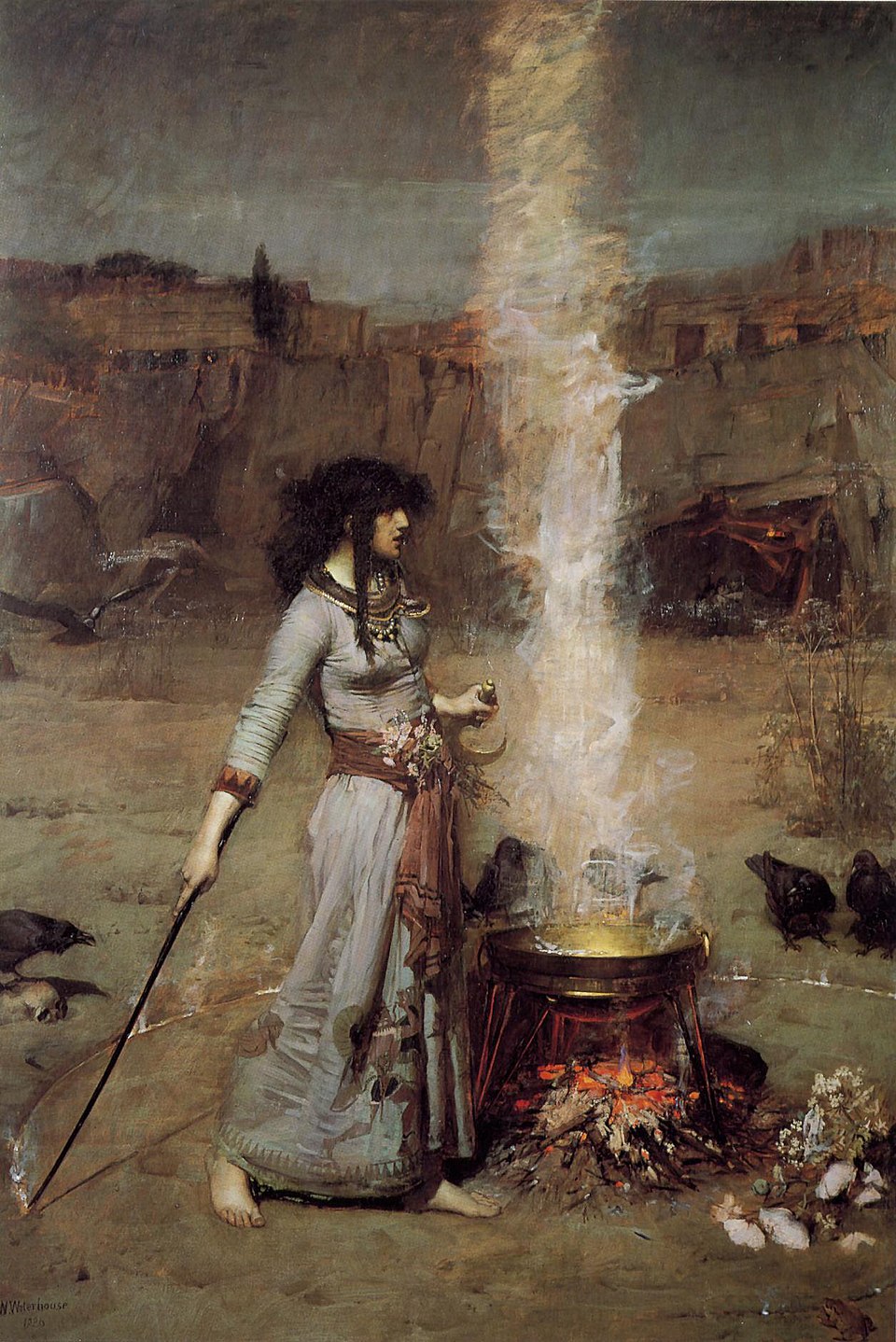
- Waterhouse painted a witch alone, drawing a circle. Is she frightening or fascinating?
- How have images of witches changed since Shakespeare's time?
Class rule: we talk about the play, its characters, history and fiction only. Nobody shares a personal fear, a family story or anything private.
Documents
Document 4: the Scottish play. Many actors believe it is bad luck to say the name "Macbeth" inside a theatre, so they call it "the Scottish play". This superstition is a tradition of the theatre world, not a historical fact about curses.
Document 5: fate or choice? The witches never tell Macbeth to kill anyone. They announce; he decides. For some critics, the witches embody fate; for others, they only reveal desires that were already there.
Activities
- Halloween in the play: list everything that belongs to the night, the supernatural and fear.
- Formal debate: "The witches are responsible for Duncan's murder." Two teams, three arguments each, a quotation for each argument, a rebuttal.
- Essay method: thesis, antithesis, synthesis; how to embed a short quotation; how to analyse a word.
Sentence starters
- Admittedly, the witches...; however,...
- It could be argued that...
- This is confirmed by the line...
- Nevertheless, Macbeth chooses to...
- Ultimately, Shakespeare suggests that...
Role play
Mock trial: Macbeth on trial. Roles: prosecutor, defence lawyer, the witches as witnesses, Lady Macbeth, Banquo's ghost, a jury. The jury votes at the end.
Gap-fill worksheet

Word bank: superstition, supernatural, fate, rebuttal, thesis, responsibility, embody, tradition
- Saying "Macbeth" in a theatre is a ______.
- Ghosts and witches belong to the ______.
- Some critics think the witches represent ______.
- An answer to the other team's argument is a ______.
- The main idea of an essay is its ______.
- Who has the ______ for the murder?
- The witches may ______ Macbeth's hidden desires.
- Calling it "the Scottish play" is a theatre ______.
Answer key
- superstition
- supernatural
- fate
- rebuttal
- thesis
- responsibility
- embody
- tradition
Homework
Write your final essay.
Watch the film at home
- The Tragedy of Macbeth (2021), directed by Joel Coen, with Denzel Washington and Frances McDormand, in black and white. Where to watch: JustWatch France.
- Macbeth (2015), directed by Justin Kurzel, with Michael Fassbender and Marion Cotillard. Where to watch: JustWatch France.
- DVD: ask at your local library or médiathèque.
- Scenes to watch: the witches on the heath (Act I), the dagger and the murder of Duncan (Act II), the banquet and Banquo's ghost (Act III), the sleepwalking scene (Act V).
Watch with English subtitles if you can. The films contain violence.
Assessment grid
| Criteria | Level 1 | Level 2 | Level 3 | Level 4 |
|---|---|---|---|---|
| Arguments | None | One | Three clear | Three clear with quotations |
| Rebuttal | None | Attempted | Clear | Sharp and relevant |
| Interaction | Rarely reacts | Reacts simply | Reacts and argues | Reacts, argues and rephrases |
| Pronunciation | Hard to understand | Understandable | Clear | Clear and expressive |
Terminale LV1 · C1/C2 extension track
For strong or anglophone students. Why the play still frightens: guilt as a modern horror.
Extended extract
Canst thou not minister to a mind diseased,
Pluck from the memory a rooted sorrow,
Raze out the written troubles of the brain?
William Shakespeare, Macbeth, Act V, scene 3 (public domain)
Pluck from the memory a rooted sorrow,
Raze out the written troubles of the brain?
William Shakespeare, Macbeth, Act V, scene 3 (public domain)
Critical analysis
- How does the play anticipate a psychological view of guilt?
- Compare with one modern horror story where the monster is inside.
- Why do audiences enjoy being frightened?
Nuanced vocabulary
| Word or phrase | Meaning and use |
|---|---|
| uncanny | strangely familiar and disturbing |
| introspection | examination of one's own thoughts |
| enduring appeal | lasting attraction |
| arguably | to present a view as defensible but open to debate |
| to hinge on | to depend entirely on |
Argued writing (C1: 300 words · C2: 400 words)
Essay: 'The most frightening ghosts are the ones we create ourselves.' Discuss.
Debate
Panel: is Macbeth more relevant today than in 1606?