TERMINALE LV1 · UPPER SECONDARY · B2 to C1 · C1/C2 extension track in every session
Session 3: Act II: the dagger, the murder and the knocking
Part 3. How does Shakespeare make the murder of Duncan terrifying without showing it?
Objectives
- Analyse the dagger soliloquy
- Study the imagery of blood and sleep
- Understand equivocation in the Porter scene
Warm-up
Image analysis. Look at the painting for one minute in silence.
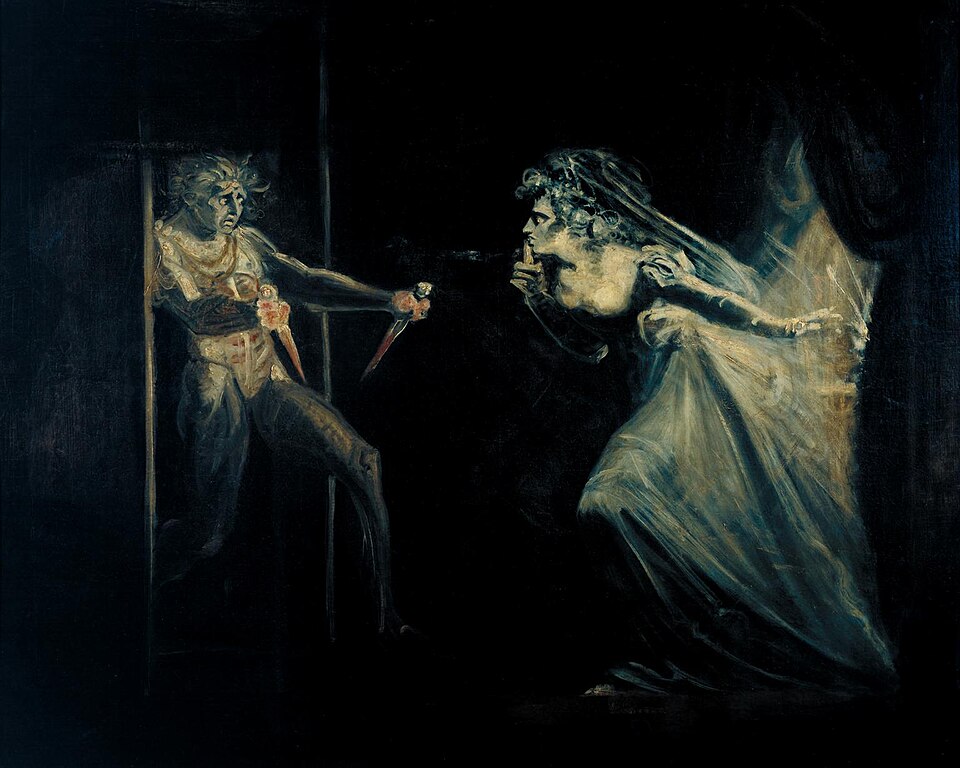
- Describe Lady Macbeth's body and Macbeth's body. What is the contrast?
- Where does the light come from? What is hidden in the shadows?
- Why might Fuseli have chosen this moment rather than the murder itself?
Documents
Is this a dagger which I see before me,
The handle toward my hand? Come, let me clutch thee.
I have thee not, and yet I see thee still.
William Shakespeare, Macbeth, Act II, Scene 1, Macbeth
William Shakespeare, Macbeth, Act II, Scene 1, Macbeth
Glossary: clutch: hold tightly · thee: you
Methought I heard a voice cry 'Sleep no more!
Macbeth does murder sleep', the innocent sleep
William Shakespeare, Macbeth, Act II, Scene 2, Macbeth
William Shakespeare, Macbeth, Act II, Scene 2, Macbeth
Glossary: methought: I thought
Will all great Neptune's ocean wash this blood
Clean from my hand? No, this my hand will rather
The multitudinous seas in incarnadine,
Making the green one red.
William Shakespeare, Macbeth, Act II, Scene 2, Macbeth
William Shakespeare, Macbeth, Act II, Scene 2, Macbeth
Glossary: Neptune: Roman god of the sea · multitudinous: countless · incarnadine: turn red
A little water clears us of this deed:
How easy is it, then!
William Shakespeare, Macbeth, Act II, Scene 2, Lady Macbeth
William Shakespeare, Macbeth, Act II, Scene 2, Lady Macbeth
Glossary: deed: act, here the murder
Faith, here's an equivocator, that could
swear in both the scales against either scale
William Shakespeare, Macbeth, Act II, Scene 3, the Porter
William Shakespeare, Macbeth, Act II, Scene 3, the Porter
Glossary: equivocator: a person who uses ambiguous words to hide the truth
Document 3: a critical view. In his essay On the Knocking at the Gate in Macbeth (1823), Thomas De Quincey argues that the knocking which follows the murder brings back the ordinary human world, and makes the audience feel the horror of what has just happened.
Activities
- The dagger soliloquy: real or "a dagger of the mind"? Find the questions and the verbs of perception.
- Scansion of "Is this a dagger which I see before me": count the syllables. What is unusual about the ending?
- Blood and water: compare Macbeth's "Neptune's ocean" with Lady Macbeth's "A little water". Which one is correct in the end?
- Equivocation: why would the Porter's joke make the 1606 audience think of the Gunpowder Plot?
- Intermediary task (oral): perform the opening of the dagger soliloquy, then explain your choices of rhythm and tone.
Sentence starters
- The questions show that Macbeth...
- The hyperbole of the ocean suggests...
- In contrast, Lady Macbeth believes...
- The knocking creates...
- The Porter's comedy...
Role play
Pairs: two servants of the castle the morning after the murder. They heard knocking and voices in the night. They try to understand without accusing anyone directly, using equivocal answers.
Gap-fill worksheet

Word bank: hallucination, hyperbole, perception, guilt, incarnadine, equivocator, offstage, feminine ending
- The dagger may be a ______ caused by guilt.
- "All great Neptune's ocean" is a ______.
- Verbs of ______ (see, feel) show Macbeth's confusion.
- The murder of Duncan happens ______.
- "To ______" means to turn red.
- The Porter imagines an ______ at hell's gate.
- An extra unstressed syllable at the end of a line is a ______.
- Macbeth's ______ prevents him from sleeping.
Answer key
- hallucination
- hyperbole
- perception
- offstage
- incarnadine
- equivocator
- feminine ending
- guilt
Homework
Learn and record the first three lines of the dagger soliloquy. Write 150 words on the blood imagery of Act II.
Watch the film at home
- The Tragedy of Macbeth (2021), directed by Joel Coen, with Denzel Washington and Frances McDormand, in black and white. Where to watch: JustWatch France.
- Macbeth (2015), directed by Justin Kurzel, with Michael Fassbender and Marion Cotillard. Where to watch: JustWatch France.
- DVD: ask at your local library or médiathèque.
- Scenes to watch: the witches on the heath (Act I), the dagger and the murder of Duncan (Act II), the banquet and Banquo's ghost (Act III), the sleepwalking scene (Act V).
Watch with English subtitles if you can. The films contain violence.
Assessment grid
| Criteria | Level 1 | Level 2 | Level 3 | Level 4 |
|---|---|---|---|---|
| Performance | Flat reading | Some expression | Expressive | Expressive, with rhythm and pauses |
| Analysis of imagery | Absent | Basic | Clear | Subtle and well supported |
| Use of critical document | None | Mentioned | Used | Discussed with own view |
| Language | Many errors | Some errors | Few errors | Accurate and varied |
Terminale LV1 · C1/C2 extension track
For strong or anglophone students. The murder is read through sound and silence.
Extended extract
Will all great Neptune's ocean wash this blood
Clean from my hand? No, this my hand will rather
The multitudinous seas incarnadine,
Making the green one red.
William Shakespeare, Macbeth, Act II, scene 2 (public domain)
Clean from my hand? No, this my hand will rather
The multitudinous seas incarnadine,
Making the green one red.
William Shakespeare, Macbeth, Act II, scene 2 (public domain)
Critical analysis
- Contrast the Latinate 'multitudinous ... incarnadine' with 'the green one red'.
- How does hyperbole express guilt?
- Why is the murder kept offstage?
Nuanced vocabulary
| Word or phrase | Meaning and use |
|---|---|
| hyperbole | deliberate exaggeration |
| incarnadine | to turn blood red |
| offstage | happening out of the audience's sight |
| arguably | to present a view as defensible but open to debate |
| to hinge on | to depend entirely on |
Argued writing (C1: 300 words · C2: 400 words)
Commentary: how does Shakespeare make guilt visible on stage?
Debate
Director's meeting: groups pitch rival stagings of the murder and defend them.