PREMIÈRE · UPPER SECONDARY · B1+ towards B2
Session 1: A king, witches and a plot: the world of Macbeth
Part 1. Why would a play about witches and the murder of a king fascinate and frighten audiences in 1606?
Objectives
- Understand the Jacobean context: James I, witchcraft, the Gunpowder Plot
- Analyse a painting and the opening scene
- Discover iambic pentameter and the witches' different rhythm
Warm-up
Image analysis. Look at the painting for one minute in silence.
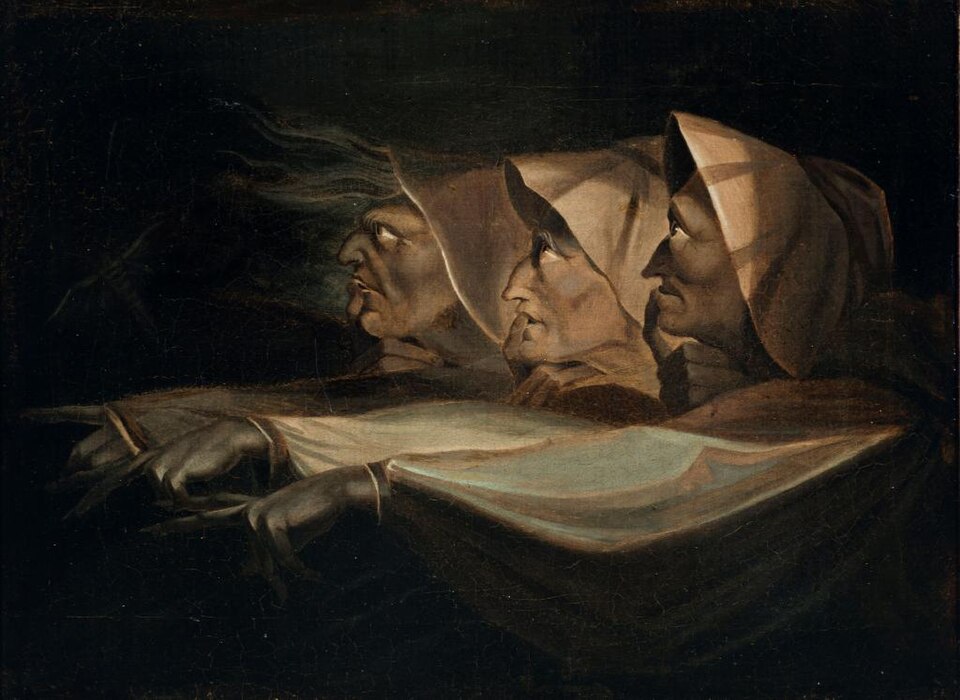
- Describe the three figures: faces, gestures, light. What is striking?
- Fuseli paints them in profile, all pointing the same way. What effect does this create?
- Why does fear often start with an image?
Documents
Document 1: Jacobean England.
- In 1603, James VI of Scotland becomes James I of England. Shakespeare's company becomes the King's Men.
- James is fascinated by witchcraft. He attended the North Berwick witch trials (1590), where women were accused of raising storms against his ship, and published Daemonologie in 1597, a treatise on witches and demons.
- On 5 November 1605, the Gunpowder Plot to blow up Parliament and the king fails. In 1606, the Jesuit Henry Garnet is tried and accused of "equivocation": answering with ambiguous words to hide the truth.
- James claimed to descend from Banquo, a character in the play.
Fair is foul, and foul is fair:
Hover through the fog and filthy air.
William Shakespeare, Macbeth, Act I, Scene 1, the three witches
William Shakespeare, Macbeth, Act I, Scene 1, the three witches
Glossary: fair: beautiful, good · foul: ugly, evil · hover: float in the air
Document 2: verse. Most of the play is in blank verse: unrhymed iambic pentameter, ten syllables, five beats (da DUM da DUM...). The witches speak differently: short rhyming lines with four beats that start on a stressed syllable. Their language sounds like a spell.
Activities
- Context jigsaw: four groups (James I, Daemonologie, the Gunpowder Plot, equivocation) prepare a two minute presentation.
- Close reading of "Fair is foul": find the paradox, the chiasmus and the alliteration. What does it announce about the play?
- Scansion: clap the rhythm of the witches' lines, then of a pentameter line. What is the difference?
- Intermediary task (oral): present your context topic and explain why it would matter to Shakespeare's first audience.
Sentence starters
- In 1606, the audience would have...
- James I was obsessed with...
- The paradox 'fair is foul' suggests that...
- The witches' rhythm differs from...
- This context explains why Shakespeare...
Role play
Pairs: a London theatre goer in 1606 and a foreign visitor. The theatre goer explains why a play about witches and regicide is thrilling and dangerous to watch with the king nearby.
Gap-fill worksheet

Word bank: paradox, treatise, regicide, equivocation, pentameter, plot, chiasmus, witchcraft
- James I wrote Daemonologie, a ______ on witches.
- The Gunpowder ______ failed in November 1605.
- Killing a king is called ______.
- Using ambiguous words to hide the truth is ______.
- "Fair is foul" is a ______: two opposites joined.
- "Fair is foul, and foul is fair" repeats the words in reverse order: it is a ______.
- A line of ten syllables and five beats is an iambic ______.
- James I was fascinated by ______.
Answer key
- treatise
- Plot
- regicide
- equivocation
- paradox
- chiasmus
- pentameter
- witchcraft
Homework
Write 150 words: "Why was Macbeth a political play in 1606?" Use three facts from the documents.
Watch the film at home
- The Tragedy of Macbeth (2021), directed by Joel Coen, with Denzel Washington and Frances McDormand, in black and white. Where to watch: JustWatch France.
- Macbeth (2015), directed by Justin Kurzel, with Michael Fassbender and Marion Cotillard. Where to watch: JustWatch France.
- DVD: ask at your local library or médiathèque.
- Scenes to watch: the witches on the heath (Act I), the dagger and the murder of Duncan (Act II), the banquet and Banquo's ghost (Act III), the sleepwalking scene (Act V).
Watch with English subtitles if you can. The films contain violence.
Assessment grid
| Criteria | Level 1 | Level 2 | Level 3 | Level 4 |
|---|---|---|---|---|
| Context knowledge | Vague | Some facts | Accurate facts | Accurate facts linked to the play |
| Literary vocabulary | Absent | Some terms | Accurate terms | Precise and well used |
| Oral presentation | Reads notes | Some pauses | Mostly fluent | Fluent and engaging |
| Pronunciation | Hard to understand | Understandable | Clear | Clear with good stress and rhythm |